— the operating system for —
SERIOUSCARRIERS.
Dispatch, safety compliance, PTI inspections, fleet maintenance, and freight billing — all connected. Built for carriers from 5 to 500+ trucks.
- Modules
- 8 Dispatch → Finance
- Screens
- 180+ Purpose-built
- Integrations
- 10+ Native connectors
- Gov't sync
- FMCSA Violations & crashes
- Offline PTI
- ⬡ Sync on reconnect
- Access control
- RBAC Dept & role level
01 — the problem
Still running freight the hard way?
The old way
- Dispatch tracked in spreadsheets and group texts
- PTI done on paper forms or separate consumer apps
- Safety records scattered across email and shared drives
- Maintenance requests managed by phone call
- Invoicing and settlements in a separate accounting tool
- No single view of load status, fleet health, or compliance
RigBase
- Live dispatch board — driver, tractor, and trailer assignment
- Offline PTI driver app with photo capture and escalation
- Safety hub: FMCSA sync, CSA tracking, DOT records, incidents
- Work orders, PM schedules, parts inventory, and vendors
- Full finance module: invoices, settlements, and fuel transactions
- Unified ops dashboard with Nexus real-time event stream
02 — modules
8 modules. Zero gaps.
Most TMS platforms cover loads and stop. RigBase covers every domain — dispatch to settlements.
Dispatch & Planning
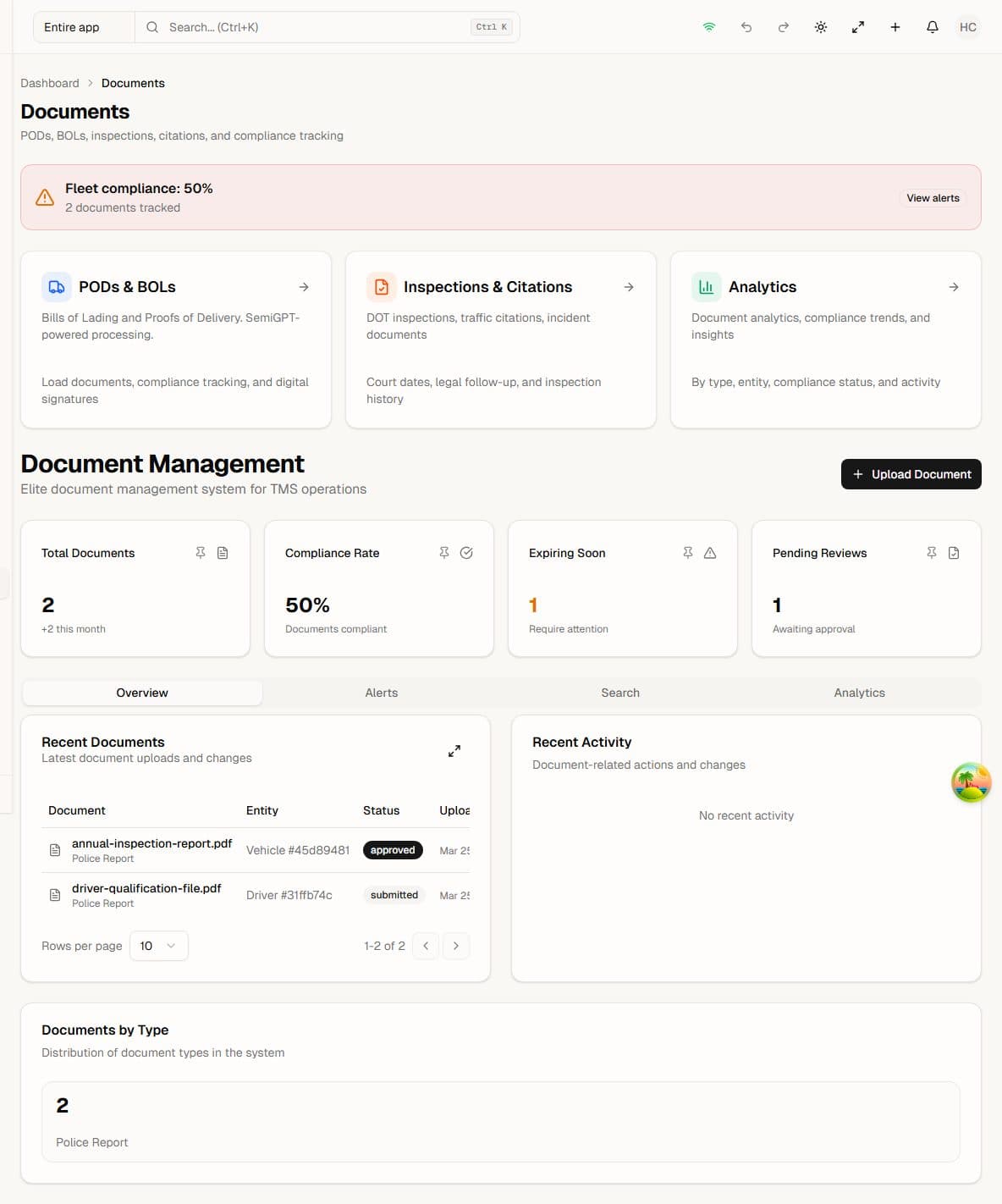
Load board · Planning board · Assignment rules · Templates
Safety & Compliance
Incidents · FMCSA sync · CSA scores · DOT inspections
Pre-Trip Inspections
Offline driver app · Photo capture · Escalation · Push reminders
Fleet Management
Tractor & trailer records · Samsara telematics · Readiness
Maintenance
Work orders · PM schedules · Parts inventory · Vendors
Documents
BOLs · PODs · Registrations · Incident files · Scanner
Finance
Invoices · Settlements · Analytics · Fuel transactions
CRM & Contacts
Customers · Brokers · Load history · Operational links
03 — real product
See it before you commit.
Actual TMS screens — not mockups. What you see is what your team uses on day one.
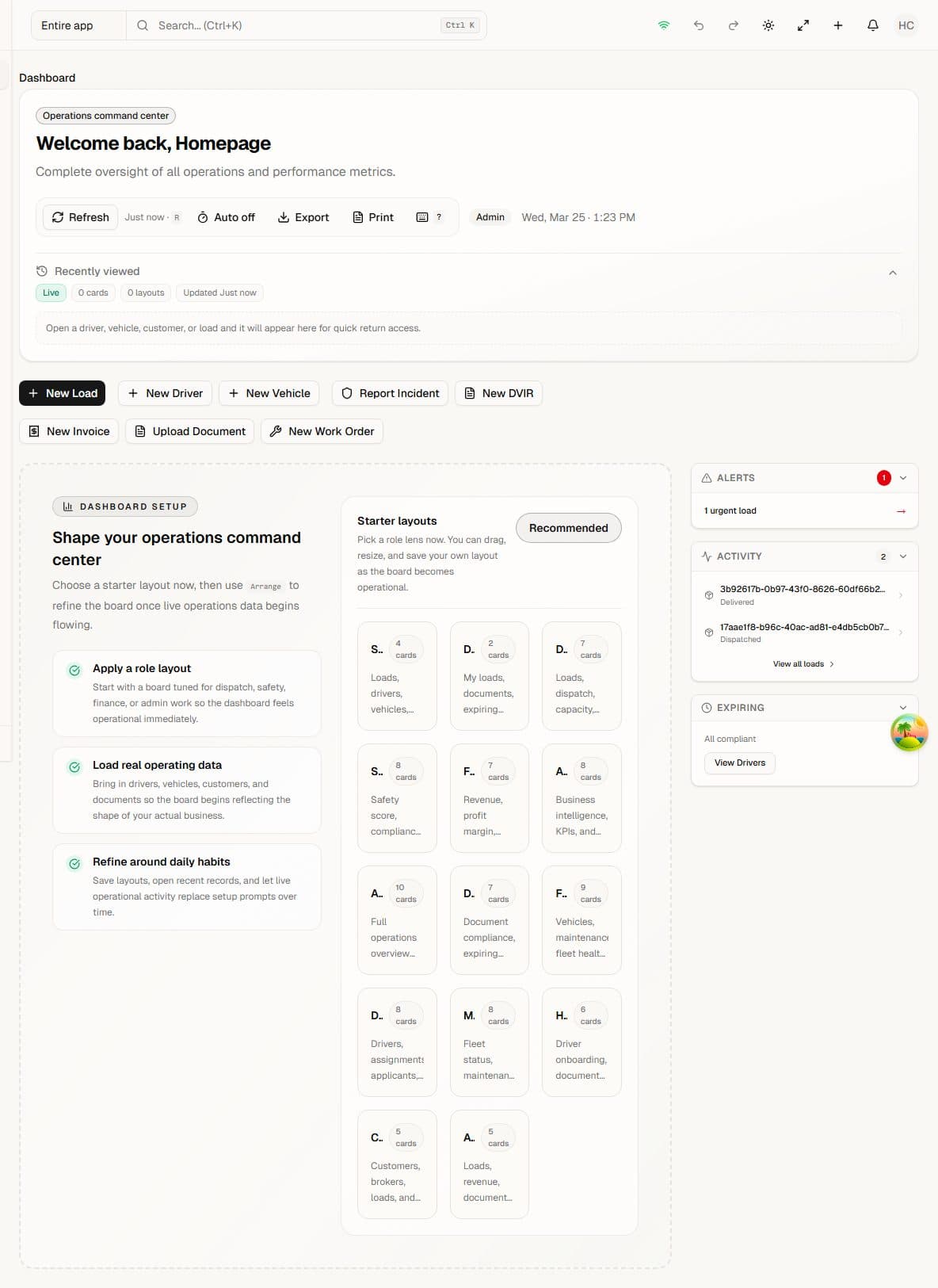
Operations overview
Cross-functional visibility for carrier leadership — loads, drivers, fleet, and safety in one view.
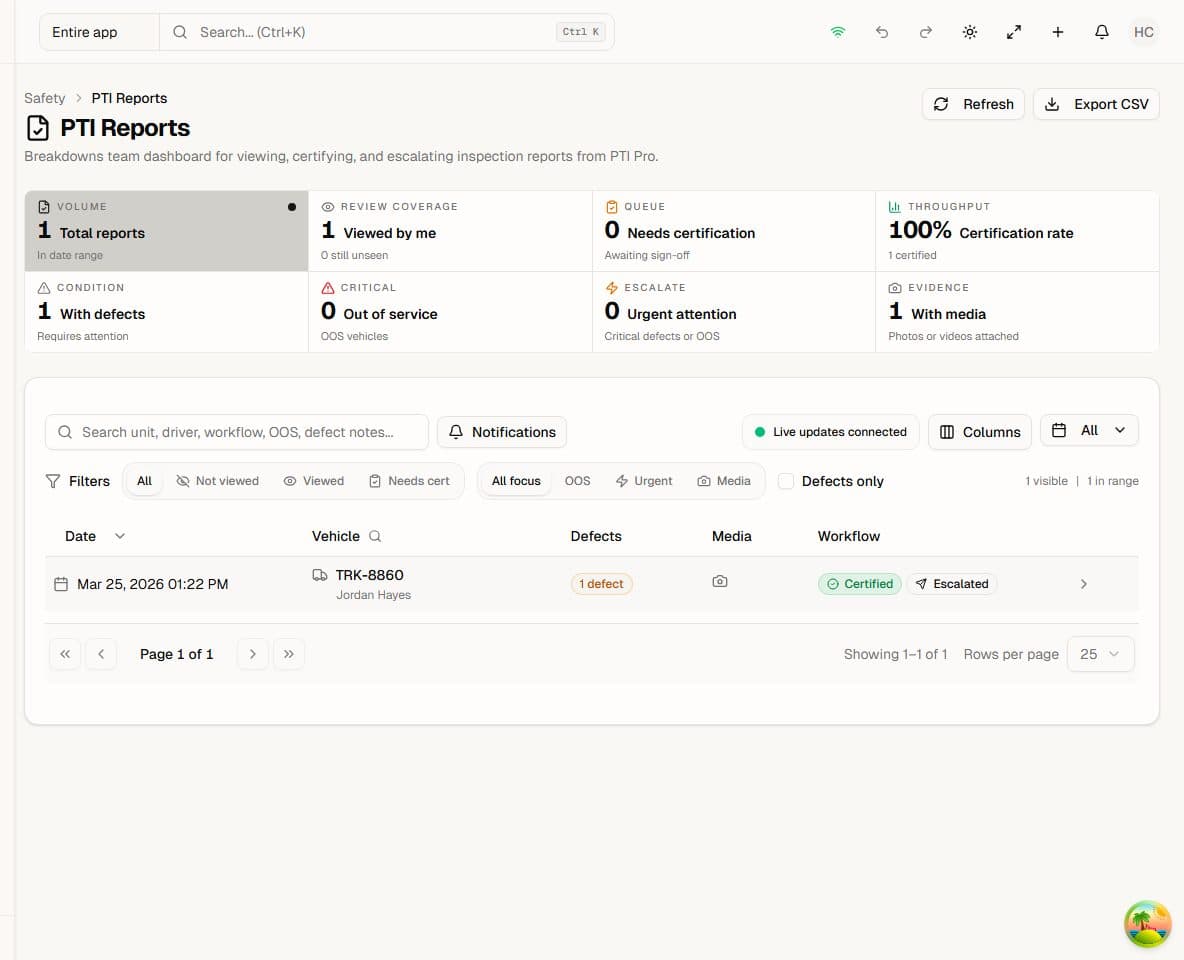
A PTI app drivers
actually use.
Not a bolted-on feature — a standalone app that works without connectivity. Drivers complete inspections anywhere. Everything syncs when they reconnect.
04 — every carrier
Scales with you.
Owner-operators to enterprise logistics — RigBase is priced and built for every stage of growth.
5 – 25 trucks
Get organized from day one.
Replace the spreadsheet habit before it becomes permanent. Set up in under an hour. No IT team required.
- Dispatch board, load records, driver profiles
- Document organization out of the box
- Self-serve onboarding — start immediately
25 – 150 trucks
Scale with process, not chaos.
Growing carriers need safety workflows, PTI compliance, and role structure before problems compound.
- Safety, PTI, and FMCSA compliance
- Maintenance work orders and PM schedules
- Role-based access across dispatcher, safety, and fleet
150+ trucks
Enterprise-grade control.
Multi-team operations need finance, analytics, integrations, and a structured rollout.
- Finance: invoices, settlements, and analytics
- Full integration suite — Samsara, fuel cards, tolling
- Guided implementation and data migration
05 — what carriers say
From the people running freight.
Real operations, real results — from carriers who replaced spreadsheets and disconnected tools with one platform.
We replaced our dispatch spreadsheet, a separate PTI compliance app, and three months of FMCSA catching-up — all in one implementation. Our safety manager called it the first tool built for how trucking actually works.
Operations Director
Regional LTL carrier · 68 trucks
The offline PTI was the deciding factor. Our drivers run through dead zones every day. Inspections still get done, photos are still captured, everything syncs when they hit a tower. No missed inspections, no compliance gaps.
Fleet Safety Manager
Refrigerated freight carrier · 140 trucks
Setup took one afternoon. Dispatchers have the load board, safety has the compliance view, I have settlements — all one system. Month-end used to take two days. It takes a few hours now.
Owner & General Manager
Dry van carrier · 22 trucks
06 — integrations
Works with your stack.
Telematics, fuel cards, tolling, weigh tickets, and government data — built in.
Telematics
Fuel Cards
Tolling
Weigh Tickets
Gov't Data
07 — platform
Built on a foundation serious carriers can trust.
Multi-tenant separation, audit trails, FMCSA data sync, and role-based access aren't add-ons — they're built into the core.
View security detailsMulti-tenant architecture
True org separation, not just data filtering
Role-based access control
Department and team-level permissions
Full audit trail
Every record change, timestamped and logged
FMCSA data sync
Violations, crashes, and inspection records
Offline PTI app
Inspections without connectivity, auto-sync
Linked evidence
Docs tied to drivers, vehicles, loads, incidents
08 — pricing
Transparent pricing for every fleet.
Three tiers based on operational complexity — not seat counts or feature gates.
Smaller fleets building discipline
Core Carrier Operations
- Dispatch board and load lifecycle management
- Driver and vehicle records
- Document control and file organization
- CRM with customer and broker records
Fleets adding people and process depth
Growth-Stage Logistics Control
- Everything in Core
- Safety, PTI, incident, and violation management
- Maintenance work orders and PM schedules
- Role-based access with department structure
Complex multi-team operations
Structured Multi-Team Rollout
- Everything in Growth
- Finance: invoices, settlements, and analytics
- Full integration suite — Samsara, fuel cards, tolling
- Guided implementation and data migration
09 — how it compares
One platform vs. stitched-together tools.
Most carriers run on spreadsheets plus 3–5 disconnected apps. RigBase consolidates dispatch, safety, PTI, maintenance, documents, and finance into a single operating surface.
10 — FAQ
Common questions about trucking TMS software.
Everything carriers ask before switching from spreadsheets to a dedicated platform.
What is a trucking management system (TMS)?
A trucking TMS is software that manages the full carrier lifecycle — dispatch and load management, driver assignments, safety compliance, pre-trip inspections, fleet maintenance, and freight billing. RigBase connects all of these in one platform, replacing the spreadsheets, paper forms, and disconnected tools that most carriers still rely on.
How much does TMS software cost for small trucking companies?
RigBase is tiered by operational complexity, not seat count. Smaller fleets (5–25 trucks) start free. Growth-stage carriers (25–150 trucks) add safety, PTI, and compliance workflows at the next tier. Enterprise operations (150+ trucks) get finance, analytics, and guided implementation.
Does RigBase have an offline PTI app?
Yes — it's a standalone driver app that works completely offline. Drivers complete pre-trip inspections anywhere, photos are queued locally, and everything syncs automatically on reconnect. No missed inspections due to poor signal at yards or truck stops.
What FMCSA data does RigBase pull?
RigBase syncs violations, crashes, and roadside inspection records directly from FMCSA. CSA scores, DOT inspection history, and driver safety records stay current without manual entry.
What integrations are included?
Native integrations include Samsara (telematics), Relay Payments, WEX, EFS, and Comdata (fuel cards), Bestpass and PrePass (tolling), CAT Scale and Weigh My Truck (weigh tickets), and FMCSA. No middleware required.
How long does setup take?
Smaller fleets complete self-serve onboarding in under one hour — no IT team needed. Larger or more complex operations get guided implementation and data migration support.
Can RigBase replace our current dispatch software?
Yes. The platform includes full dispatch board, load lifecycle management, driver and equipment assignment, planning board, and template workflows. Most carriers also replace their safety tools, PTI apps, maintenance trackers, and document storage in the same move.
Is it built for small fleets and owner-operators?
Yes. RigBase scales from 5 to 500+ trucks. Start free, get running immediately, and activate more modules as the operation grows.
More questions? Talk to the team or explore all platform modules.
— take the next step
See it live with your
operation in mind.
30 minutes. No scripted slides. Walk through dispatch, safety, PTI, and fleet with context from how your carrier actually runs. Most carriers leave with a rollout timeline.
FMCSA-READY · OFFLINE PTI · SETUP < 1 HOUR · NO CREDIT CARD